
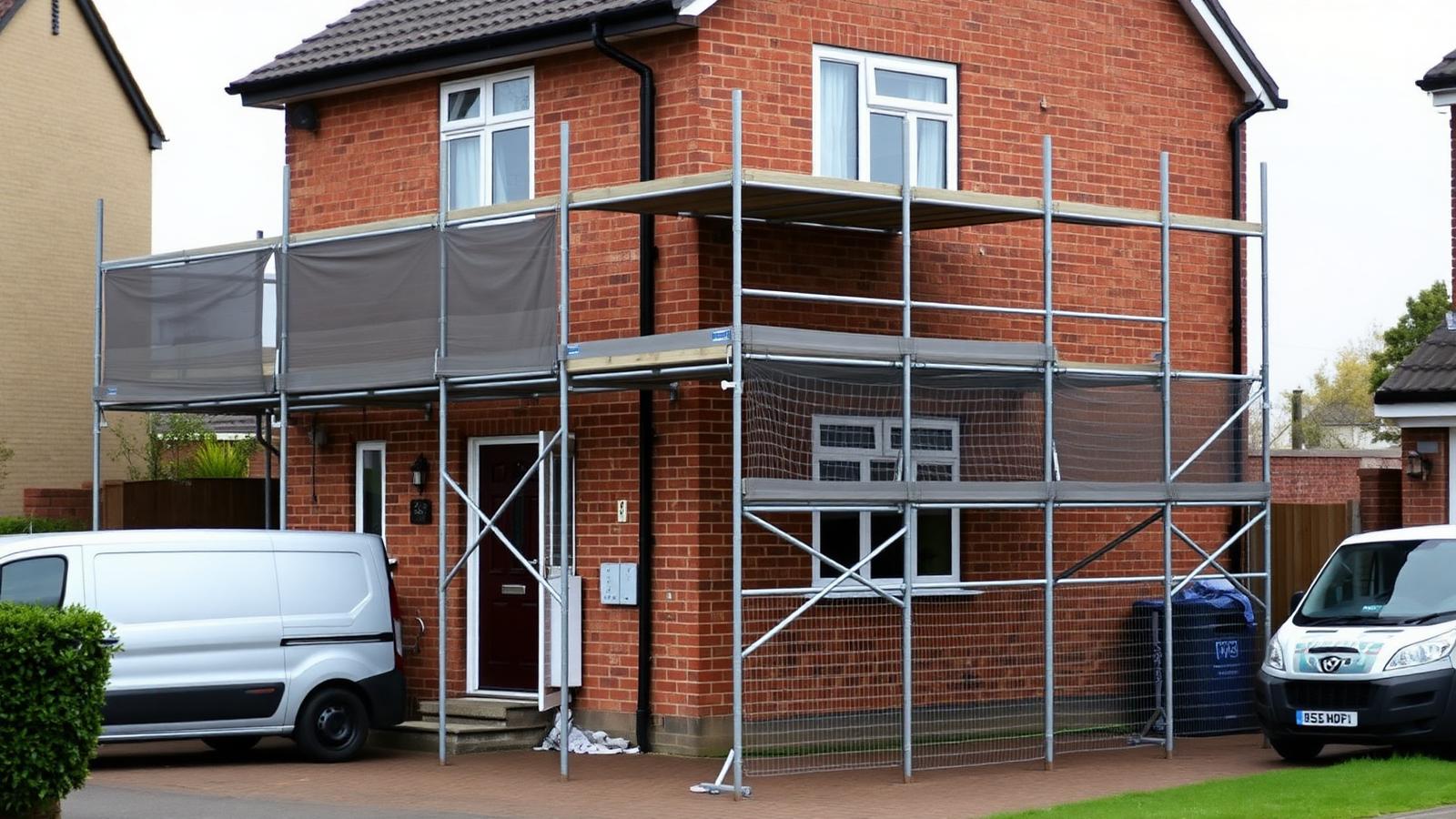
Residential scaffolding price ranges by job type
The single biggest driver of price is what the scaffolder has to design and how much steel ends up on site. Day rates are a poor way to compare quotes; what matters is the scope, the hire window, and what's included. Here's what we see most weeks across Essex and Suffolk for honest, fully-insured CISRS work:
| Job type | Typical cost (4-week hire) | Erect time |
|---|---|---|
| Single side elevation, two-storey semi | £550–£900 | 4–6 hrs |
| Front + side, two-storey detached | £900–£1,400 | 6–8 hrs |
| Full perimeter, no chimney | £1,200–£1,800 | 1 day |
| Full perimeter + chimney drop | £1,400–£2,400 | 1–1.5 days |
| Three-storey townhouse, full wrap | £1,800–£2,800 | 1.5–2 days |
| Bungalow, single elevation | £380–£620 | 3–4 hrs |
These are real working ranges, not website fillers. Anyone quoting £250 for a two-storey scaffold is either uninsured, uncarded, or building something that won't pass an HSE inspection. Anyone quoting £4,000 for a single elevation is padding.
What actually moves the price
1. Hire duration beyond four weeks
The base quote almost always assumes a four-week hire. Beyond that, you're paying a weekly extension. Typical extensions sit at £35–£90 per week depending on scaffold size. Spartan includes the first extension week free on residential jobs — most scaffolders don't.
2. Pavement licence and pedestrian protection
If the scaffold sits on the public footway, you need a licence from the local highway authority. Essex County Council and Suffolk County Council both charge a fee (typically £50–£200 depending on duration), and the scaffold then needs lighting, signage and a 1.2 m clear pedestrian width — sometimes a full pedestrian gantry. That can add £200–£700 to a town-centre job.
3. Chimney drops and cantilevered platforms
A chimney drop adds typically £300–£600 to a standard scaffold. The structure has to be designed independently, and the cantilever needs counter-weight. Don't accept a quote that promises a chimney drop without an engineer's calc when the stack is non-standard.
4. Restricted access
If your rear elevation has no vehicle access (common in Victorian terraces across Hertford, Bocking and Cambridge), tube and fittings have to be hand-balled through the property. Floor protection, additional labour time, and a slower erect — typically £100–£250 added.
5. Distance from yard
Haulage is a real line item. A scaffolder running materials 60 miles to your job is paying for two return trips with a 7.5-tonne wagon. That cost lands somewhere on your invoice. Local matters.
Cost comparison — like-for-like quote
Here's a real worked example for a four-bed Edwardian semi in SG14 needing a re-roof. Three quotes received in the same week:
| Item | Quote A | Quote B | Quote C |
|---|---|---|---|
| Scaffold base price | £780 | £1,650 | £1,420 |
| Chimney drop | Not included | Included | Included |
| Hire period | 2 weeks | 6 weeks | 4 weeks + 1 free |
| Insurance proof | Not provided | £5m PL | £5m PL + EL £10m |
| CISRS card check | None | On request | Presented at handover |
Quote A looks cheapest until you add the chimney drop, the missing weeks of hire and the absence of insurance. Quote C is what a fair, insured local job actually looks like.
Common cost mistakes
- Not asking what's included. Pavement licence? Pedestrian gantry? Hire extension rate? Strike included or charged separately?
- Booking on price alone. Cheap scaffold becomes expensive scaffold the day a tile drops or a neighbour's car is hit.
- Paying a deposit. Reputable residential scaffolders don't ask for deposits on jobs under £2,500. Payment is usually 50% on erect, 50% on strike.
- Skipping the survey. A verbal estimate over the phone is a guess. Insist on a 24-hour written quote after a site visit.
If you'd like a fixed written quote on your job, our residential scaffolding service page covers the full scope and turnaround commitments. We also publish coverage detail for Hertford, Braintree and Harlow.