
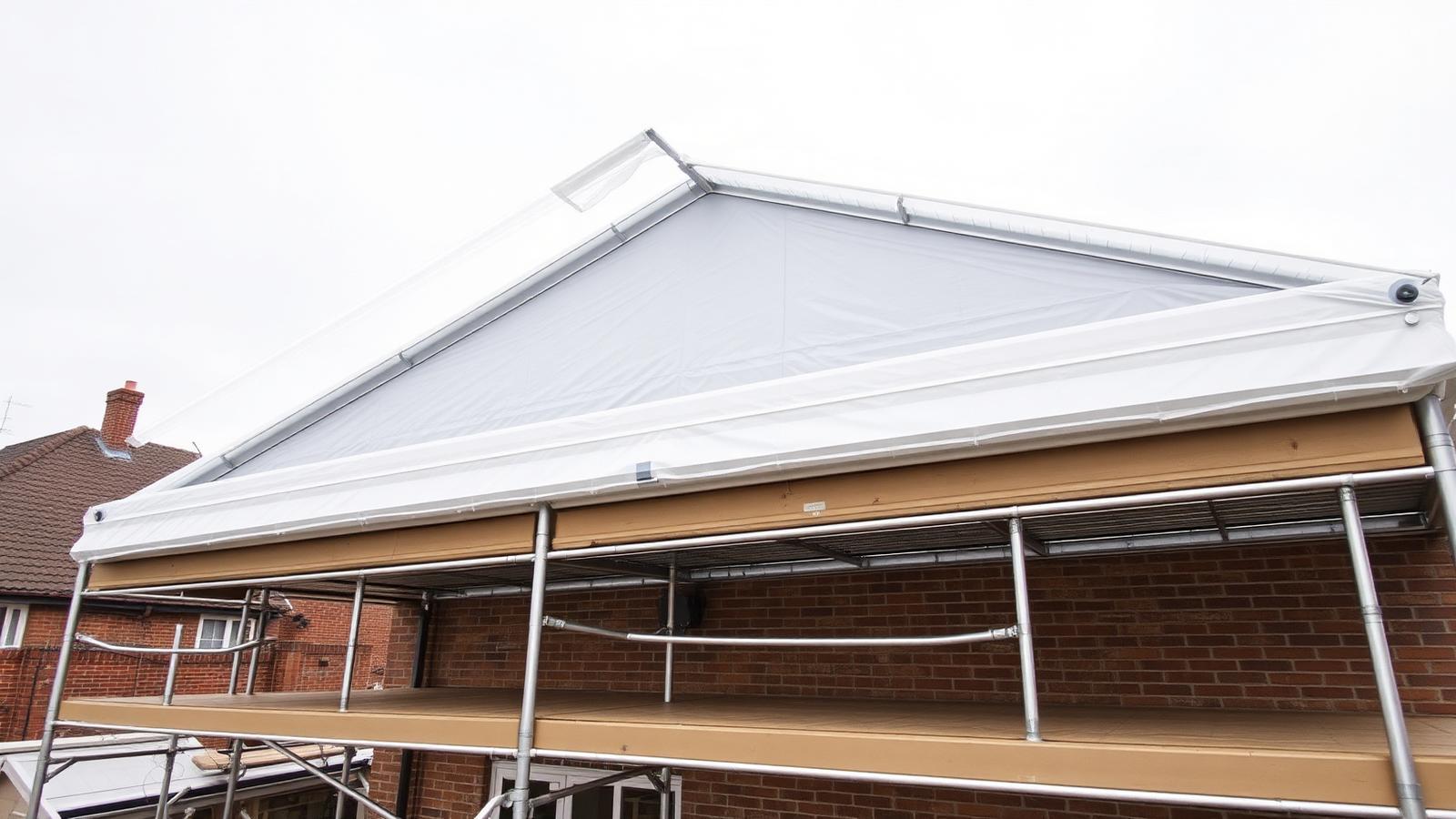
How a temporary roof scaffold actually works
It's a structure on top of a structure. The base scaffold (independent or putlog) provides the working access platform. The temporary roof sits above it, spanning eaves to eaves with engineered beams — typically aluminium beams up to 12 m clear span, or steel beams beyond that. The beams carry purlins, the purlins carry the sheeting, and the sheeting carries the weather.
Three sheeting options are common in the UK:
- Shrink-wrap PVC: Heat-tensioned over a frame, gives a near-rigid skin. Best for windy sites and longer hire periods. Lasts 12+ weeks.
- Reinforced PVC tarpaulin: Mechanically fixed in panels. Quicker to install, easier to remove. Suits hire windows under 8 weeks.
- Corrugated steel sheeting: For very long projects (12 weeks+) or where falling-object protection above the cover is needed.
When you genuinely need one
Re-roofs lasting more than 48 hours
Once a roof is stripped, the property is open to the weather. A four-day tile-and-batten replacement done in dry July weather might survive on tarpaulins. The same job in October won't — and a single rain band onto exposed ceilings is a £4,000–£15,000 secondary-damage claim.
Structural roof works
Truss replacement, ridge rebuilds, gable extensions, parapet rebuilds. Any work that removes the roof structure (not just the surface) needs a sheeted weather cover for the full duration.
Heritage and listed re-roofs
Lime-mortar walls and exposed timber frames cannot get wet during a re-roof. The cost of damage is not just financial — it's irreversible. Listed building consents almost always require a temporary roof on works longer than 72 hours.
Autumn and winter works
October through March in the UK, any roof work that exposes more than 2 m² of structure should have a sheeted cover. The probability of three rain-free days in a row is too low to plan around.
When you probably don't need one
- Single-tile or flashing-strip repairs (under 1 m² exposure)
- One-day re-roofs in stable July/August weather where the roofer can complete strip-and-cover same-day
- Chimney-only work where the surrounding roof remains intact (use a chimney-drop scaffold with a localised tarp instead)
- Solar panel installations where the roof structure stays in place
Comparison: tarpaulin vs temporary roof
| Factor | Tarpaulin | Temporary roof scaffold |
|---|---|---|
| Cost | £100–£400 | £2,000–£8,000+ |
| Setup time | 1–2 hours | 1–2 days |
| Wind resistance | Up to ~15 m/s before failure | Up to 25 m/s engineered |
| Watertightness over time | Days | Months |
| Allows trade to work in any weather | No | Yes |
| Use case | Emergency, days only | Planned re-roof, weeks–months |
For a deeper comparison see our tarp vs temporary roof guide, or jump to temporary roof scaffold costs.
Practical considerations
Span limits
Standard aluminium beam systems clear span up to 12 m. Beyond that you're into steel beam systems with intermediate support — significantly more expensive. Most UK domestic properties (semi-detached, terrace, modest detached) sit comfortably within the aluminium range.
Wind loading
A sheeted temporary roof is a large sail. Designed correctly, it carries wind loads up to ~25 m/s. Designed badly, it lifts off in a Beaufort 6 and does more damage than the storm. Always insist on a written design calc for any temporary roof — not a back-of-envelope sketch.
Pavement licence implications
A temporary roof typically extends 0.5–1.0 m beyond the eaves. If your scaffold sits on or near the public highway, the temporary roof footprint usually requires a wider pavement licence than a standard scaffold. Build the licence into the timeline.
If you're planning a re-roof or major roof works, our temporary roof scaffolding service page covers our standard designs, hire periods and pricing approach.